
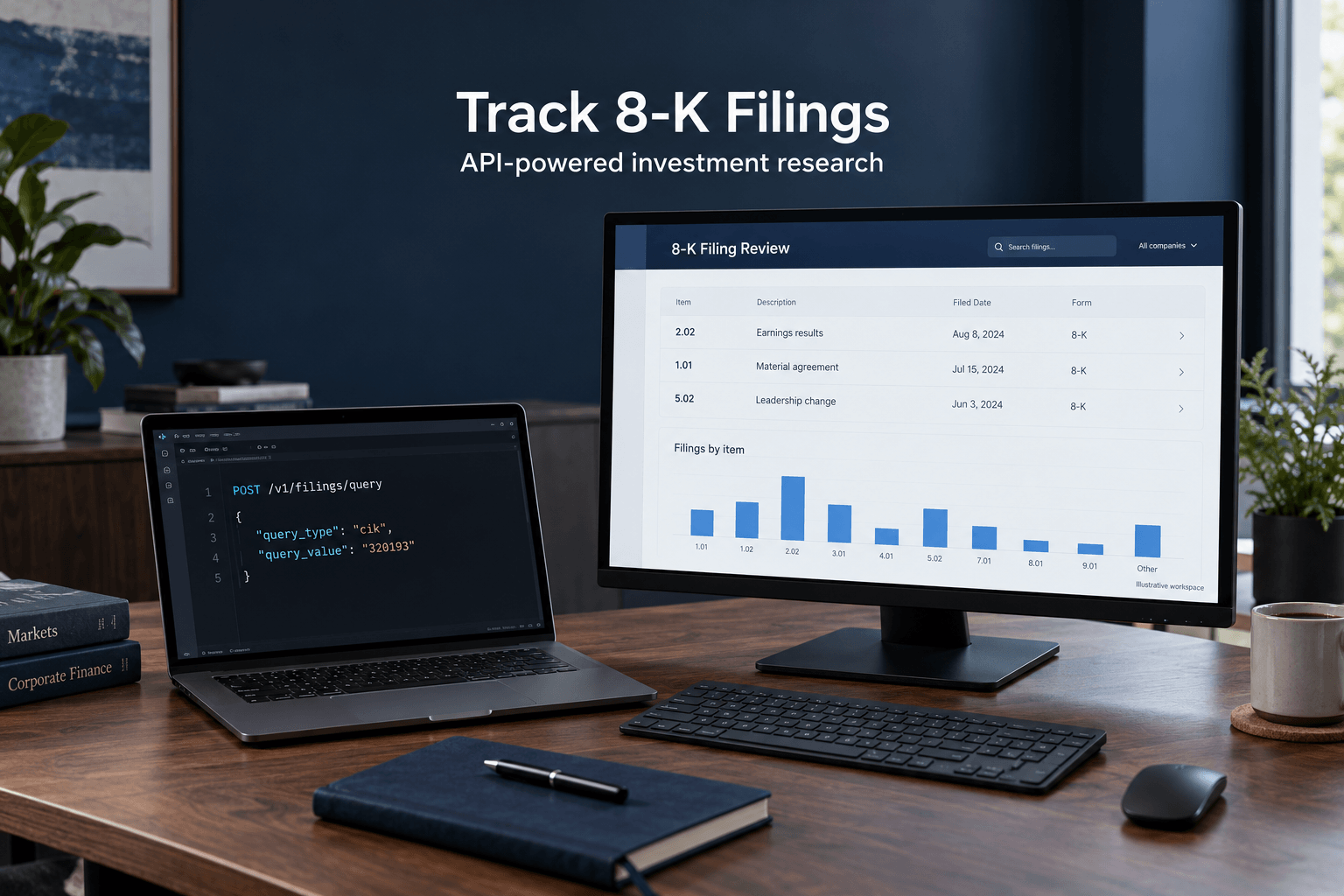
An 8-K filing reports certain events between scheduled company reports. A useful review identifies the issuer, reads the disclosure and exhibits, considers context, and records what to check next. This guide provides that process using SEC EDGAR and verified SEC Filing Data features.
8-K filing review workflow
- Choose the companies and event types relevant to your research.
- Find Form 8-K filings by issuer, form, and date; verify the company’s legal name and CIK.
- Review the filing index, item headings, original report, and relevant exhibits.
- Compare the disclosure with prior filings and the company’s financial and operating context.
- Record confirmed facts, open questions, and follow-up dates; check later filings or amendments.
Common Form 8-K items: quick reference
These common items can help you triage a filing. This is a quick reference, not a complete list of reportable events or exceptions.
| Item | SEC form item name | Why an investor may review it |
|---|---|---|
| 1.01 | Entry into a Material Definitive Agreement | Terms of a material agreement outside the ordinary course |
| 2.02 | Results of Operations and Financial Condition | Public release of material results for a completed quarter or year |
| 2.03 | Creation of a Direct Financial Obligation or an Obligation under an Off-Balance Sheet Arrangement of a Registrant | New or material debt and other financial obligations |
| 3.02 | Unregistered Sales of Equity Securities | Potential proceeds, security terms, or dilution |
| 4.02 | Non-Reliance on Previously Issued Financial Statements or a Related Audit Report or Completed Interim Review | Notice that prior statements or a related report/review should no longer be relied on |
| 5.02 | Departure of Directors or Certain Officers; Election of Directors; Appointment of Certain Officers; Compensatory Arrangements of Certain Officers | Specified leadership or board changes and related arrangements |
| 9.01 | Financial Statements and Exhibits | Index of attached financial statements, pro forma information, and exhibits |
What an 8-K tells investors
Form 8-K is a public company’s “current report” for events specified by SEC rules and certain public disclosures. It provides current information between annual Form 10-K and quarterly Form 10-Q reports. For a definition and broader context, see What Is an 8-K Filing.
A report may contain multiple items and exhibits. Investors use 8-Ks to update their understanding between periodic reports, while assessing each disclosure in light of its terms, timing, and company context.
Set the scope of your watchlist
Start with a focused issuer list and research question. Depending on your work, prioritize liquidity, debt, earnings, financing, or governance. Record each legal name, ticker, and CIK (Central Index Key, the SEC identifier). Since tickers can change or be reused, verify the entity before attributing a filing.
Find filings and verify the issuer
On SEC.gov, search by company name, ticker, or CIK; select Form 8-K and narrow by filing date. SEC EDGAR’s search includes filing text and allows entity and form refinements. Verify the legal name and CIK. Filing date may differ from the event date or period covered.
SEC Filing Data is a third-party provider; SEC.gov remains EDGAR’s original source. The Query API documentation lists metadata queries by ticker, CIK, company name, or form type, with pagination. Its overview advertises filing-date/time-range search, but the parameter table omits date fields and an example mentioning startDate/endDate does not define them. Full-text search is listed as coming soon. Confirm endpoint behavior before automating; verify disclosures against the SEC record.
Which 8-Ks deserve closer review first?
When time is limited, consider closer review of Items 4.02 (non-reliance), 1.03 (bankruptcy or receivership), 1.05 (material cybersecurity incidents), 4.01 (auditor changes), and 2.03 (financial obligations). This is a research triage aid, not a ranking or automatic red flag. Assess the disclosure and exhibits against the company’s size, finances, prior filings, and terms.
Review the filing, report, and exhibits
Open the SEC filing index and review each layer:
- Metadata: Confirm registrant, CIK, form type, filing date, accession number, and event date if shown. An accession number uniquely identifies a submission.
- Item headings: Note all items, since one event may trigger multiple disclosures.
- Original report: Read what happened, when, who is involved, and what remains conditional or unresolved. Do not treat a proposed transaction as completed.
- Exhibits: Open the relevant press release, agreement, presentation, or other attachment. The report may summarize terms that are set out in an exhibit.
Metadata identifies the filer, date, and form; the 8-K is the registrant’s report; exhibits are attachments. Extracted data can aid processing but does not replace the original report or contract. SEC Filing Data’s Extractor API documents extraction from supported 8-Ks by SEC URL, form type, and item number. Compare results with the source.
Check for amendments such as 8-K/A, which may add or correct information. Also note whether information is marked “filed” or “furnished.” Under the form’s instructions, information furnished under Items 2.02 or 7.01 generally is not treated as filed for Section 18 purposes unless the registrant specifies otherwise or incorporates it by reference. That distinction does not make the disclosure irrelevant; read its status as the form instructs.
Hypothetical examples: earnings and financing
- Hypothetical earnings: You monitor a retailer near its expected results announcement. Find its 8-K, confirm the issuer, and review Item 2.02 and the earnings-release exhibit. Record reported sales and margins, guidance, and explanations that differ from the prior quarter. Then compare the release with the company’s previous 10-Q.
- Hypothetical financing: You are assessing a small manufacturer’s liquidity. Review its recent 8-Ks for Items 1.01, 2.03, or 3.02. If a filing reports a material agreement, obligation, or unregistered equity sale, inspect the terms before estimating proceeds, repayment requirements, conversion features, or possible dilution. Compare those terms with cash and debt disclosed in its latest periodic report.
Both scenarios are hypothetical and do not describe actual company filings or API results. An item label helps you locate a disclosure; it does not define the terms for the company.
Interpret the disclosure in company context
Turn disclosures into research questions. Check an agreement’s duration, conditions, termination rights, and obligations; compare financing proceeds with maturity, interest, covenants, and potential share issuance; and note the role, timing, reason, and successor in leadership changes. Compare the event with recent reports. Terms and company context matter; do not infer that a filing caused or predicts a stock-price move.
Keep a repeatable tracking log
Choose a cadence that fits your research: review actively monitored holdings each market day, and a broader universe daily or weekly. Use notifications only when verified for your tool. SEC Filing Data currently marks its real-time filing stream as “Coming soon,” so it is not available for live alerts.
Keep one log entry per filing:
| Field | What to record |
|---|---|
| Issuer | Legal name, ticker, and CIK |
| Filing reference | Filing date, form, accession number, and SEC document link |
| Event | Item number(s), event date, and a factual one-sentence summary |
| Evidence reviewed | Main report and relevant exhibit names |
| Context | Prior filing, financial metric, or open question |
| Follow-up | Research action and date to revisit |
Write verifiable notes such as “agreement includes a minimum purchase commitment through 2029,” not conclusions such as “major growth catalyst.” Close the loop when an amendment, closing announcement, later 10-Q, or other filing answers the open question.
Deadlines and limits
Unless otherwise specified, an 8-K is filed or furnished within four business days after the event. If it occurs on a Saturday, Sunday, or SEC holiday, the count begins on and includes the next business day. Item 7.01 and an Item 8.01 report used solely for Regulation FD follow Rule 100(a) timing. For Item 1.05, the four-business-day period starts when the registrant determines the incident is material. Under Item 1.05(c), a written Attorney General determination of substantial risk to national security or public safety can support an initial delay of up to 30 days, an additional 30 days if disclosure continues to pose a substantial risk to national security or public safety, and, in extraordinary circumstances, a final additional 60 days if it continues to pose a substantial risk to national security; further relief may require SEC exemptive relief. Separately, if a registrant subject to 47 CFR 64.2011 must delay data-breach disclosure under that rule, Item 1.05(d) allows the applicable period under 64.2011(b)(1), capped at seven business days after the required notification. The registrant must notify the SEC through EDGAR correspondence no later than the original Form 8-K due date. Check the current form for item-specific rules.
Not every important development appears in an 8-K, and an initial report may be amended. Headlines and metadata can prioritize review but cannot replace the disclosure. An 8-K is one research input; it does not establish suitability or predict an outcome.
Frequently asked questions
Do all important developments trigger an 8-K filing?
No. Form 8-K requires reports for events specified in its items, while Item 8.01 lets a company disclose other events at its option. Monitoring 8-Ks will not capture every company update or replace periodic reports and other research.
Use the same sequence each time: choose what to monitor, verify the issuer, read the report and exhibits, compare the disclosure with company context, and record the next question. An 8-K filing is evidence for investment analysis, not a conclusion on its own.